Artificial Intelligence vs Human Intelligence: Key Differences Explained
What Is Artificial Intelligence and What Is Human Intelligence?
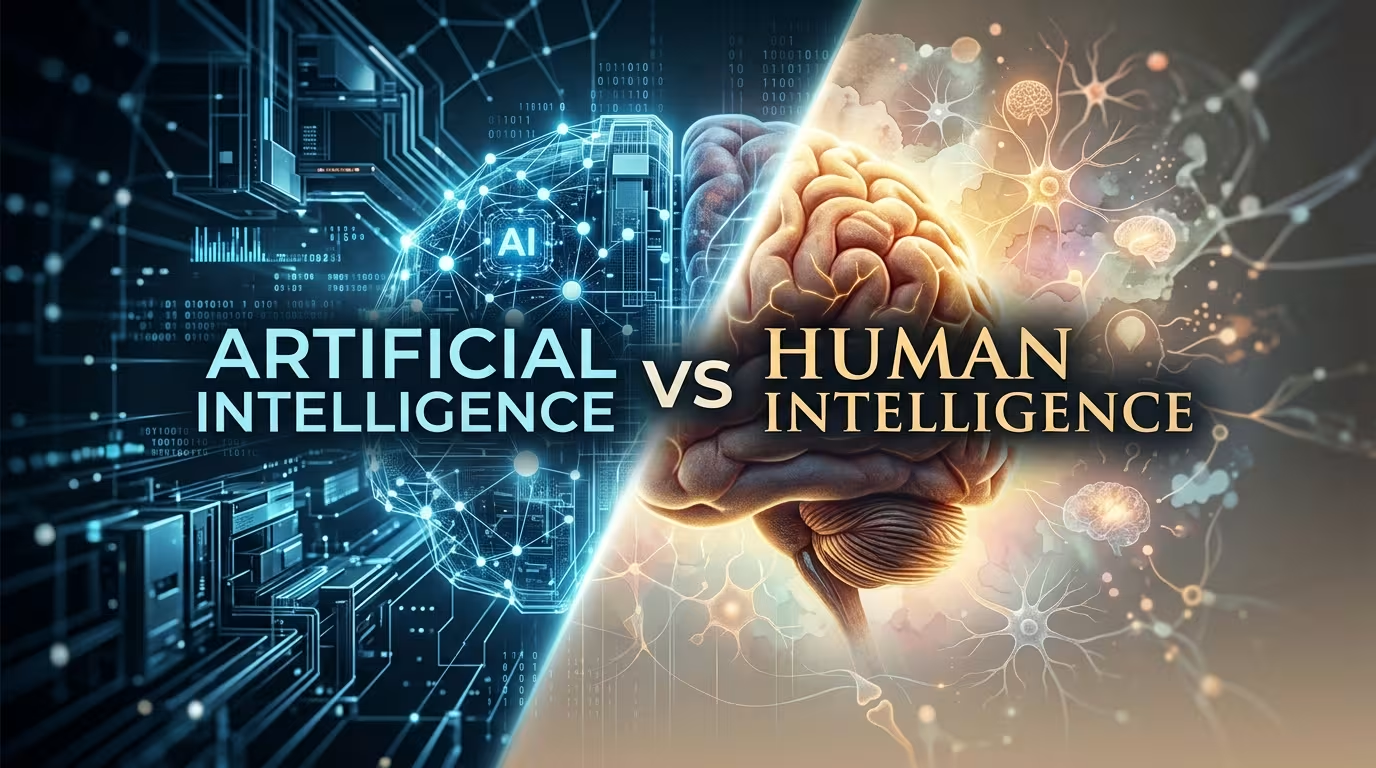
Artificial intelligence is a system built to perform specific cognitive tasks: analysing data, recognising speech, translating languages, and generating predictions. It does this without any conscious understanding of what it is doing. Technologies like machine learning, deep learning, and NLP allow AI to improve through exposure to data, but only within the boundaries of its training set. Human intelligence is biological and multi-dimensional. It combines logical reasoning with emotional awareness, social intuition, and moral judgment.
No current AI architecture replicates this combination. AI narrows in on a single task with precision. Human intelligence connects unrelated ideas, reads context, and generates original meaning. For professionals exploring how these capabilities apply in practice, the artificial intelligence courses in Saudi Arabia at Skillvotech cover AI fundamentals, machine learning, NLP, and computer vision through instructor-led training.
How AI and Humans Learn Differently
AI learns through exposure to labelled datasets and feedback loops. Supervised learning trains models on input-output pairs. Reinforcement learning rewards correct actions through repeated trial and error. But AI cannot transfer knowledge between unrelated domains without complete retraining on new data. Human learning works differently. A person can learn from a single example, transfer skills across unfamiliar contexts, and adjust behaviour based on emotion, culture, and social cues. A child recognises sarcasm from tone alone. No training dataset is needed. This gap in transfer learning is why AI dominates narrow, repetitive tasks but fails at the cross-domain reasoning human intelligence handles daily.
Processing Speed: Where AI Wins and Where It Fails
AI processes information millions of times faster than any human brain. A large language model scans a billion-word corpus in seconds. A human researcher might take weeks to review a fraction of that volume. In structured tasks like financial modelling, diagnostic imaging analysis, and logistics routing, raw computational speed gives AI a clear advantage. Speed without contextual understanding breaks down fast. Human intelligence evaluates nuance, weighs emotional consequences, and recognises when a technically correct answer is socially or ethically wrong. In Saudi Arabia’s healthcare sector, AI-powered diagnostic tools process radiology scans faster than any physician. But the treating doctor’s judgment, shaped by patient history, cultural context, and clinical instinct, stays irreplaceable for treatment decisions.
Problem-Solving: Logic vs Creativity
The difference between artificial intelligence and human intelligence is sharpest in problem-solving. AI follows algorithmic logic. It evaluates every possible path within defined parameters and selects the statistically optimal outcome. This makes it strong for structured problems like supply chain optimisation, fraud detection in banking, and route planning at scale. Human problem-solving is non-linear. People use analogy, intuition, and lateral thinking to navigate problems they have never seen before. A crisis manager facing an unprecedented emergency cannot rely on historical data patterns. They improvise, adapt, and act on incomplete information. This type of adaptive problem-solving is something current AI architectures, including transformer-based models, cannot replicate.
Creativity and Emotional Intelligence
AI generates images, composes music, and writes text. Every output is a statistical recombination of patterns in its training data. It is not a creative act driven by intention, feeling, or lived experience. Generative AI tools powered by diffusion models produce visually strong results but carry zero emotional depth or original meaning. Human creativity comes from personal experience, cultural identity, and emotional vulnerability. These qualities make art, storytelling, and innovation meaningful. Emotional intelligence, the ability to read, interpret, and respond to another person’s feelings, is central to leadership, negotiation, and trust-building. No AI model scores on empathy. Roles in education, counselling, executive coaching, and professional development training stay human for this reason.
Memory and Information Storage Compared
AI has near-unlimited storage capacity and millisecond recall. A database never forgets a record, never distorts a fact, and retrieval time stays constant regardless of volume. Vector databases now allow AI systems to store and retrieve contextual meaning alongside raw data, not just keyword matches. Human memory is selective, associative, and emotionally weighted. People forget irrelevant details and prioritise experiences that carry personal significance. This is a feature, not a flaw. Selective recall shapes personal identity, deepens relationships, and builds social context that no storage system replicates. AI stores information with perfect fidelity. Human intelligence gives information meaning.
Decision-Making: Algorithms vs Ethics
Human intelligence vs artificial intelligence splits widest in decision-making. AI calculates probabilities across large datasets and selects the statistically optimal choice. It performs best when outcomes are measurable and variables are well-defined: credit scoring, ad targeting, predictive maintenance scheduling. Human decision-making integrates factors no algorithm captures. Ethics, empathy, cultural norms, lived experience, and long-term social consequences all play a role. A judge sentencing a case, a doctor choosing a treatment pathway, a team leader resolving a workplace conflict. Each weighs dimensions that exist outside any dataset. In Saudi Arabia, the Saudi Data and Artificial Intelligence Authority (SDAIA) deploys AI across government services using a human-in-the-loop model. Every algorithmic recommendation passes through a human ethical review before implementation.
Current Limitations of AI and Human Intelligence
AI’s biggest limitation is the absence of self-awareness. It optimises for objectives without understanding what those objectives mean or why they matter. Hallucinated outputs, bias inherited from training data, and adversarial vulnerability remain unresolved even in advanced models. Current AI also lacks common-sense reasoning. A system that defeats a grandmaster at chess cannot explain why a person is crying. Human intelligence has its own constraints. Cognitive fatigue, emotional bias, limited working memory, and processing speed that cannot match machines. Yet humans reason through incomplete and contradictory information daily. They weigh context, read intent, and make judgment calls under uncertainty. The computational gap is narrowing. The consciousness gap is not.
Real-World Applications in Saudi Arabia and Beyond
AI is transforming industries at scale. Conversational AI automates customer interactions. Computer vision improves medical diagnoses. Autonomous logistics networks move goods faster. Smart grids optimise energy distribution. In Saudi Arabia, AI deployment is accelerating under Vision 2030. NEOM’s smart city project integrates AI into urban planning and citizen services.
Saudi Aramco uses machine learning for predictive well maintenance. Saudi financial institutions run real-time AI-driven fraud detection systems protecting millions of transactions daily. Human intelligence drives the areas where empathy, judgment, and relational skills matter. Education, crisis management, diplomacy, and AI training programmes for corporate teams depend on both human reasoning and structured AI knowledge working together. The strongest outcomes happen when AI handles data-heavy computation and humans set the strategic direction.
Ethical Considerations and AI Governance
AI raises ethical questions that technology alone cannot answer. Should an autonomous system make life-or-death medical decisions? How do organisations prevent algorithmic bias from reinforcing systemic discrimination? Both the European Union’s AI Act and Saudi Arabia’s AI Ethics Framework, developed and governed by SDAIA, mandate transparency, fairness, accountability, and human oversight in high-risk AI deployments. Human intelligence provides the moral framework for evaluating every one of these questions. Accountability, cultural awareness, and empathy cannot be encoded into model weights. They must be exercised by people. As AI systems grow more powerful and more autonomous, the human role shifts from operator to ethical gatekeeper.
The Future of AI and Human Intelligence Working Together
The future is not AI replacing human intelligence. It is AI amplifying it. The model gaining ground across industries is augmented intelligence: AI handles data processing, pattern recognition, and repetitive computation while humans contribute creativity, ethical reasoning, and strategic vision. Across Saudi Arabia’s workforce, this collaboration is already visible. AI-powered analytics platforms inform business decisions in real time. Human leaders interpret those results through market knowledge, cultural context, and organisational judgment.
Professionals who understand both artificial intelligence and human intelligence will hold the most strategic roles going forward. Structured AI and machine learning courses build the technical foundation needed to work alongside AI systems in any Saudi industry. The organisations that perform best will deploy AI and human intelligence together, not choose one over the other.
Frequently Asked Questions
What is the main difference between artificial intelligence and human intelligence?
AI processes data through algorithms and pattern recognition. Human intelligence uses consciousness, emotion, and moral reasoning to solve problems. (24 words)
Can artificial intelligence replace human intelligence?
No. AI automates data-driven tasks but cannot replicate human creativity, empathy, ethical judgment, or adaptive reasoning in unpredictable situations.
Is AI smarter than the human brain?
AI is faster at processing large datasets. Human intelligence is superior in creative thinking, emotional understanding, and reasoning through incomplete information.
How is Saudi Arabia using artificial intelligence?
Saudi Arabia deploys AI through Vision 2030 across healthcare, banking, smart cities like NEOM, and government services managed by SDAIA.
What are the biggest limitations of AI compared to human intelligence?
AI lacks self-awareness, common-sense reasoning, and emotional understanding. It produces unreliable outputs when training data contains bias.
Take the Next Step in AI Training
Understanding the difference between artificial intelligence and human intelligence is where it starts. Building hands-on AI skills is what moves your career or your team forward. Skillvotech delivers artificial intelligence courses in Saudi Arabia covering machine learning, NLP, computer vision, and generative AI. Programmes run in instructor-led, online, and onsite formats across Riyadh, Jeddah, Dammam, and Khobar.