
Generative AI vs Machine Learning Training: Which Path Fits Your Team?
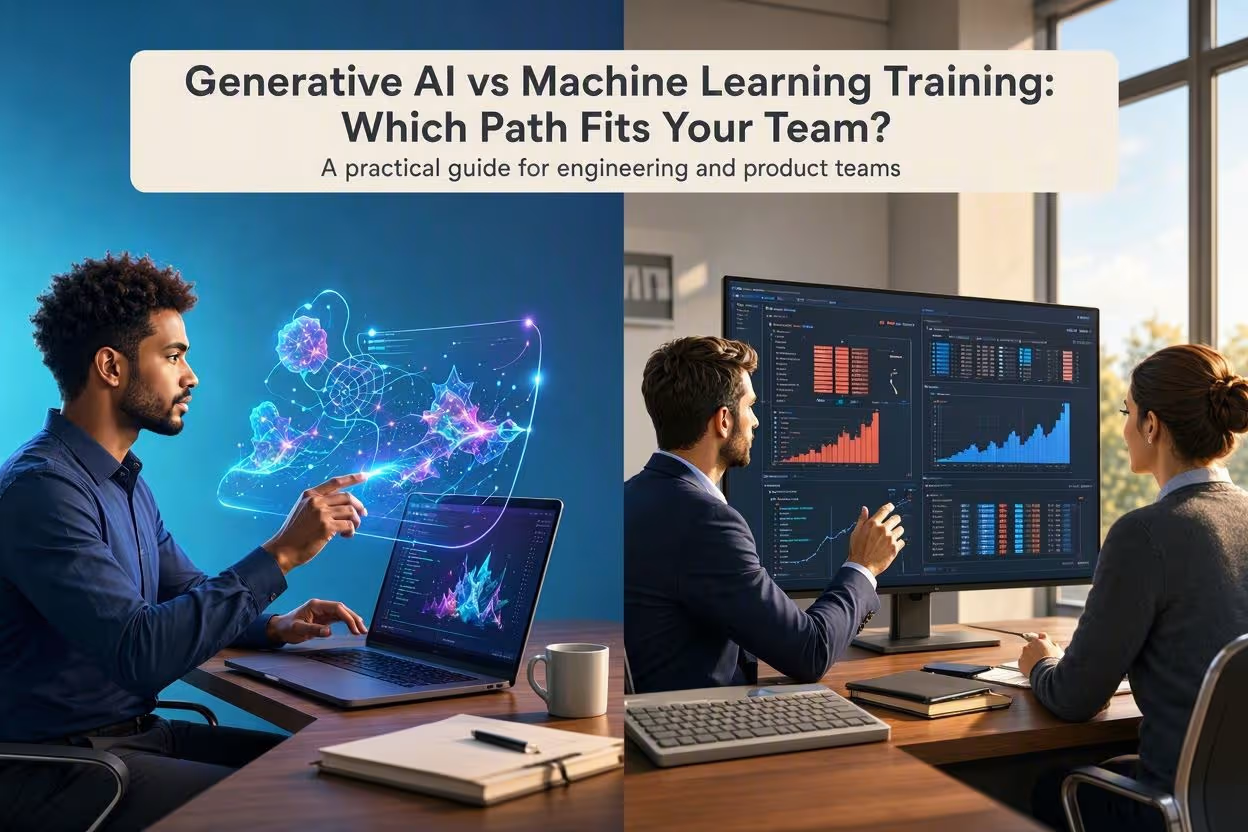
Generative AI vs machine learning training comes down to one relationship: generative AI is one of four categories of machine learning systems, alongside supervised, unsupervised, and reinforcement learning, according to Google’s own machine learning course, a distinction worth getting right before comparing training curricula.
Generative AI alone could add nearly $7 trillion, about 7 percent, to global GDP over ten years, according to Goldman Sachs research cited by AWS. Still, that categorization is pedagogical more than strict: generative models are often built using supervised or reinforcement-learning techniques underneath, worth knowing before choosing a training path through corporate training courses in Saudi Arabia.
Machine Learning Is the Broader Field
Machine learning covers any system trained on data to make predictions or generate content, spanning far more than the chatbots and image generators most people picture first. A fraud-detection model flagging unusual transactions, a demand-forecasting tool predicting next month’s inventory needs, and a recommendation engine suggesting products are all machine learning, none of them generative.
The core idea, per Google’s own course material, is training a piece of software called a model to make useful predictions or generate content from data, rather than hand-coding every rule a traditional program would need.
A weather-prediction system built the traditional way requires modeling fluid dynamics equations directly, an approach that gets harder to maintain as the number of variables grows.
An ML approach instead trains a model on historical weather data until it learns the relationship between conditions and outcomes on its own, without anyone writing the underlying physics by hand.
Supervised and Unsupervised Learning
Supervised learning trains a model on data that already has the correct answers attached, the way a student studies old exams with both questions and answers included.
Two common supervised tasks show up constantly in Saudi corporate settings: regression, predicting a numeric value like expected revenue, and classification, sorting items into categories like flagging a transaction as fraudulent or legitimate.
Most early ML projects inside a company start with one of these two, since both map directly onto a business question someone already asks manually.
Unsupervised learning instead looks for patterns in data with no labeled answers at all, useful for grouping customers by behavior or catching anomalies nobody defined in advance. A retailer segmenting customers into buying-pattern clusters without first defining those segments manually is a textbook unsupervised use case.
Reinforcement Learning
Reinforcement learning trains a model through trial and reward rather than labeled examples, the approach behind systems that learn to play games or optimize a process step by step.
Saudi corporate teams reach for it far less often than the other three categories, since it needs a clearly defined reward signal that most business problems do not naturally have.
It still underpins some of the more advanced automation and robotics work entering the market, particularly in logistics and industrial settings where a system needs to improve its own decisions over repeated cycles rather than follow a fixed rule set.
Generative AI Is a Subset, Not a Separate Field
Generative AI is a subset of machine learning that generates new content meaningfully and intelligently, according to AWS’s own definition, rather than only classifying or predicting from existing data. That single distinction resolves most of the confusion around whether a given tool counts as one or the other.
A traditional ML model might predict whether a contract clause is high-risk; a generative model can draft a replacement clause in the same style as the rest of the document, which is the cleanest way to tell which category a given tool actually belongs to.
Foundation Models Behind Generative AI
Foundation models sit behind most generative AI tools in active use today: large models trained on broad text and image data, capable of performing a wide range of general tasks like answering questions, writing, and summarizing.
Foundation-model providers across the industry are built on this approach, which became commercially viable at scale starting around 2022, following earlier advances in deep learning architectures during the late 2010s.
That timeline matters for training planning too, since the field is young enough that most Saudi teams are still building genuine early-mover expertise.
What Foundation Models Change About Training
Teams evaluating generative AI courses Saudi Arabia providers offer should confirm the curriculum covers foundation models directly, prompting technique, and output evaluation, beyond tool clicking alone. A course that skips the underlying model behavior leaves participants unable to judge when an output is unreliable.
Which Path Fits Your Team
Choosing between generative AI training and machine learning training Saudi Arabia providers offer depends on what your team is trying to build. The three scenarios below cover most real teams, including the common case where a single project genuinely needs both skill sets at once.
Choose Machine Learning Training When
The goal is prediction, classification, or forecasting from existing structured data, fraud detection, demand forecasting, churn prediction, or anomaly detection. Teams in banking, energy, and logistics building these systems need a foundation in the statistical and modeling concepts machine learning training actually teaches.
Choose Generative AI Training When
The goal is producing new content, drafting documents, summarizing reports, generating code, or building conversational tools. Teams already working with large language models and foundation-model APIs get more direct value from a GenAI vs ML course structured around prompting, foundation models, and content generation than from a general ML curriculum.
Choose Both When Neither Fits Cleanly
Many real Saudi projects blend both categories in a single system. A customer service system might use supervised learning to route tickets and generative AI to draft the actual reply.
That combination is why our generative AI and machine learning training at Skillvotech KSA covers the full category map instead of treating GenAI and ML as competing tracks.
A Worked Example: One Project, Both Categories
Consider a Riyadh bank building a loan-review assistant. A supervised classification model scores each application’s default risk based on historical outcomes, a purely predictive task with no content generation involved. A generative layer then drafts the reviewer’s summary explaining that score in plain language, citing the specific factors that drove it.
Neither half works well alone. The classification model without the generative layer produces a risk score a human still has to translate into a written justification by hand.
The generative layer without the classification model has no reliable risk signal to explain in the first place, only a fluent-sounding guess. Training a team to build this kind of system means training both skill sets together.
Where This Fits Inside a Broader AI Strategy
Getting this distinction right matters beyond the classroom, and it shows up first in how a company reports its own AI use. SDAIA’s National Strategy for Data & AI, approved in 2020 and building toward its 2030 industry-leader phase, shapes exactly this kind of governance expectation for Saudi organizations.
Reading how that strategy plays out in practice shows why naming the right category matters for compliance reporting, not just curriculum planning.
A governance audit asking what AI systems a company runs gets a very different answer depending on whether “AI” means a fraud-detection model or a customer-facing chatbot, and that answer increasingly needs to be precise rather than a general “we use AI” statement.
Naming the specific category also gives an auditor something concrete to act on, which a vague label rarely provides.
Reading how computer vision and deep learning specializations compare rounds out the picture further, since both sit inside the same broader machine learning category as the four types covered here, just applied to a narrower domain.
The Verdict on Generative AI vs Machine Learning Training
Generative AI training and machine learning training cover different parts of the same field, and most Saudi teams doing serious AI work eventually need pieces of both, whether that becomes obvious in week one or after the first real project stalls.
Teams building prediction and classification systems should start with machine learning fundamentals; teams building content generation and conversational tools get more direct value starting with generative AI and foundation models.
The mistake to avoid is picking a track based on which term is trending rather than what the team is actually building.
Frequently Asked Questions
What is the difference between AI and machine learning?
AI is the broad goal of making machines act intelligently; machine learning is one approach to achieving it, training models on data rather than hand-coding rules.
Is ChatGPT AI or machine learning?
Both. ChatGPT is a generative AI system, which is itself one category of machine learning, built on a large language foundation model.
When did generative AI become commercially viable?
Advances in cloud computing made generative AI commercially available at scale starting around 2022, though the underlying techniques trace back to the late 2010s.
Do I need machine learning training before I can learn generative AI?
No. Generative AI training can start directly with foundation models and prompting, though understanding the broader ML categories helps explain why the tools behave the way they do.
Can one training program cover both generative AI and machine learning?
Yes, and for teams whose projects blend prediction and content generation, a combined program is usually more practical than two separate tracks.
Build the Right AI Skills with Skillvotech KSA
Skillvotech KSA delivers both generative AI and machine learning training across Riyadh, Jeddah, and Dammam, mapped to whether your team is building prediction systems, content generation tools, or both. Request a corporate training proposal to match the right track to your team’s actual project.


